
- Home
- Athletes’ counter
- Disciplines
Disciplines
Biomechanical and Tactical Specificity of SAMBO: Opportunities for Athletes with Visual Impairment
SAMBO, as a combat sport, represents an integrated system incorporating elements of various martial arts and wrestling disciplines, originally developed for physical training and self-defense purposes. SAMBO is characterized by a distinctive style in which athletes work from a low stance, maintain close contact through gripping, and frequently disrupt the opponent’s balance through direct force application and pressure.
Power Throws in SAMBO
Power throws are techniques executed primarily through direct muscular force and body control. They constitute a significant part of SAMBO’s technical arsenal due to the sport’s characteristic stance dynamics and jacket-gripping system.
The versatility of SAMBO is reflected in its wide range of techniques, allowing visually impaired athletes to adapt movements without loss of effectiveness by relying on tactile sensitivity and contact-based control, selecting tactilely driven technical variations while avoiding maneuvers that depend heavily on visual tracking and distance perception.
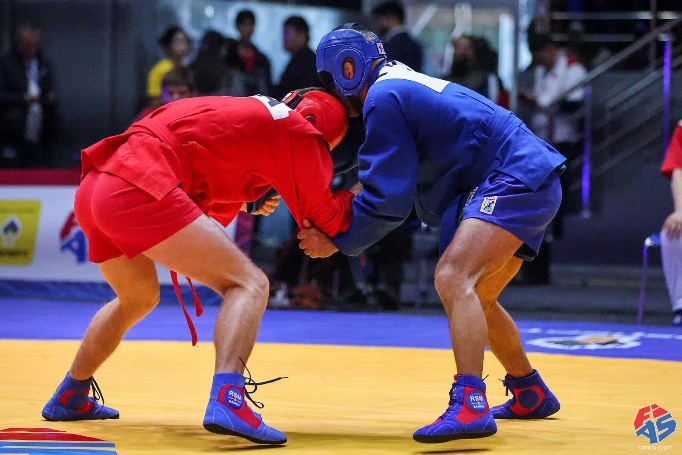
Biomechanics of the Low Stance in SAMBO
The fundamental stance in SAMBO is characterized by a low center of gravity: the legs are bent at the knees, the feet are positioned approximately shoulder-width apart with a slight diagonal orientation, and the torso is inclined forward. This posture increases horizontal stability and reduces body displacement during pushing, pulling, and off-balancing actions.
Such positioning broadens the base of support, while balance corrections require less precise adjustment. Proprioceptive feedback from the ankle joints clearly detects the moment when body weight shifts beyond the support area. In this stance, body inclinations are also easier to perceive: proprioceptors in the ankles, knees, and lower back receive stronger sensory input even during small positional changes.
The low stance minimizes vertically disorienting accelerations, reducing stress on the vestibular system and concentrating sensory processing within the horizontal plane, where proprioceptive mechanisms — particularly through ankle joint feedback — function more effectively in correcting lateral imbalance. This contributes to technically efficient movement and control in athletes with visual impairment.
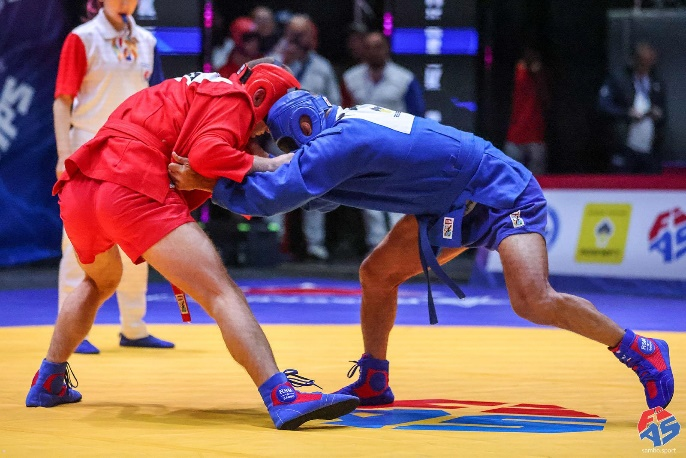
Equipment
The SAMBO jacket (kurtka, or sambovka) fits tightly to the body and promotes close-contact interaction, allowing the athlete to maintain effective tactile control over the opponent’s body movement through gripping. The combination of a low stance and the close fit of the sambovka minimizes excess leverage created by loose fabric and empty space between the athlete’s grip and the opponent’s body. This allows force to be transferred more directly and efficiently during pushing and pulling actions while maintaining maximal tactile feedback and body control.
Visual Control
For blind SAMBO athletes, techniques that rely heavily on visual tracking are more difficult to execute effectively, including certain high-amplitude rotational throws and long-range leg sweeps. However, this limitation is compensated for by the broad technical arsenal of SAMBO and the multiple ways techniques can be adapted and performed without compromising competitive integrity or technical effectiveness.
Partially sighted athletes may effectively apply techniques that require visual engagement due to the close-contact nature of SAMBO. Nevertheless, they cannot compete on entirely equal terms with athletes without significant visual impairment, as visually impaired athletes generally require more time to restore balance under vestibular stress, which affects reaction speed and technical efficiency. Like blind athletes, they also require continuous gripping contact, though in this case the grip additionally serves to maintain the maximum distance at which visual monitoring of the opponent’s movement remains possible.
One victory – many paths.
In SAMBO, the 4/2/1 scoring system allows for different and equally valid ways to achieve victory — through throws of varying amplitude and cleanliness, holds, and submission techniques (including leg locks), which can both earn significant points and lead to a direct victory.
A single basic technique in Sambo has multiple variations in entry, execution, and finishing. It can be combined and adapted to the opponent, forming flexible pathways to the result. This creates tactical freedom and allows for dynamic combat based on tactile and proprioceptive perception.
-
"Overcoming" 5 MayFIAS Backs Adaptive SAMBO Research Project for Children with Autism
-
"Overcoming" 29 AprilScott BAILEY: “What really stood out was the brotherhood you see through sport”
-
Did you see it? 18 DecemberSAMBO Federation Sri Lanka Meets with Minister of Youth Affairs and Sports
-
Personalities 21 OctoberFedor Emelianenko and Islam Makhachev to attend World SAMBO Championships in Tashkent
-
President 21 OctoberSAMBO exhibition opens at Moscow Railway Station in Saint Petersburg ahead of 50th World SAMBO Championships
-
Federations 19 OctoberFirst Beach SAMBO Tournament Under Youth Development Project Held in Venezuela
- Watch World Sambo Championships 2022. Bishkek, Kyrgyzstan 17 November 2022
-
Personalities 21 OctoberFedor Emelianenko and Islam Makhachev to attend World SAMBO Championships in Tashkent
-
President 21 OctoberSAMBO exhibition opens at Moscow Railway Station in Saint Petersburg ahead of 50th World SAMBO Championships
-
Federations 19 OctoberFirst Beach SAMBO Tournament Under Youth Development Project Held in Venezuela